Chapter 4
The Product Development Cycle in Action
The launch gets the glory, but speed is forged in the quiet grind — choosing the next best step, gating with reviews, and turning feedback into fuel.
Step Inside
The launch gets the glory. Speed is forged in the grind.
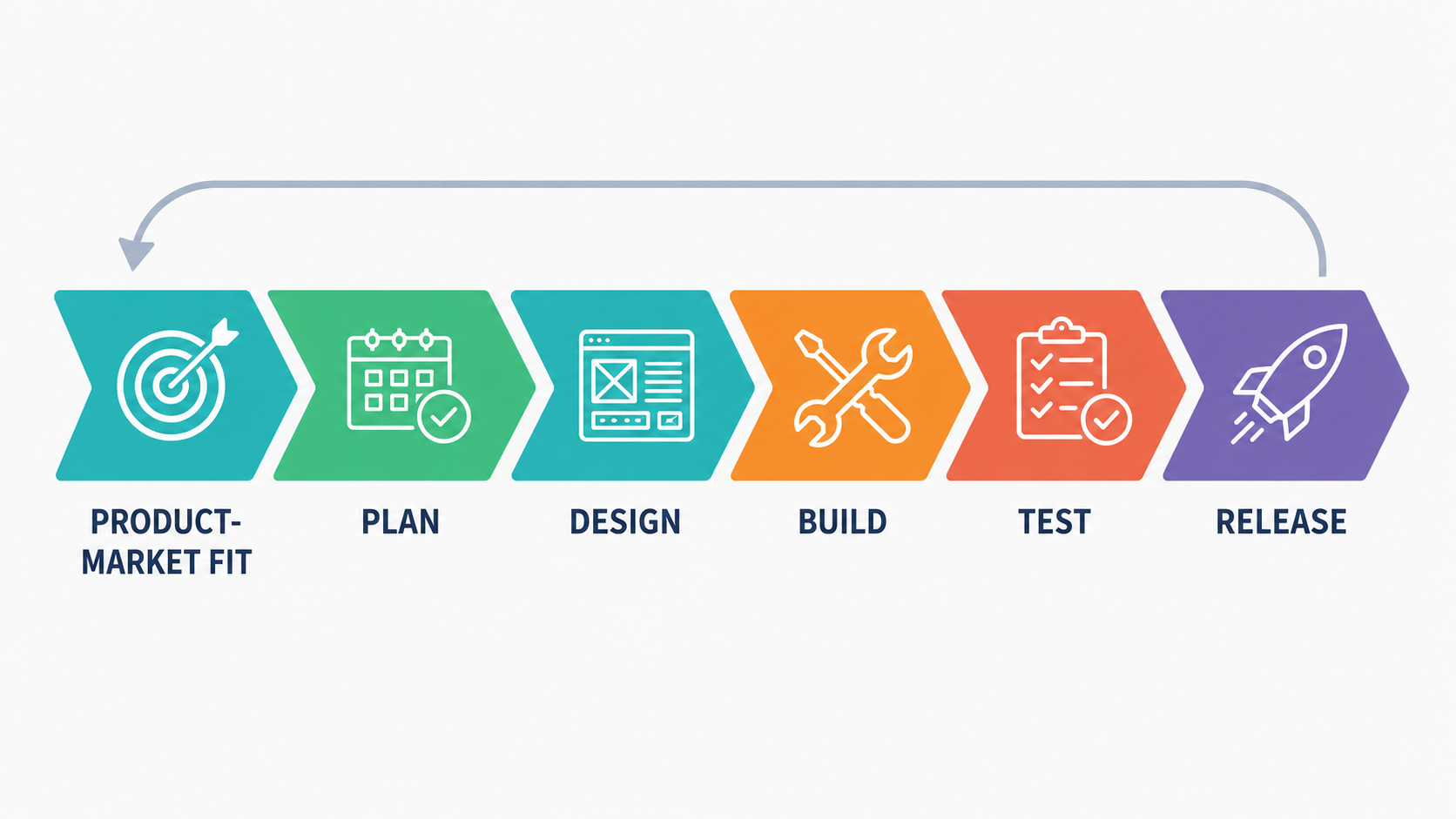
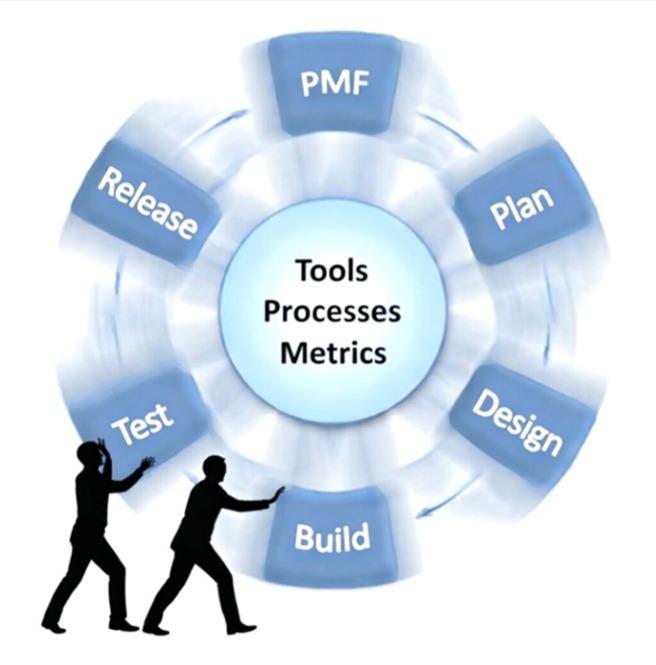
Product–Market Fit grounds every decision in validated customer need — without it, even flawless execution builds the wrong thing. Plan aligns intent and risk. Design stabilizes interfaces so teams can run in parallel. Build limits WIP and integrates continuously. Test validates assumptions with explicit criteria and safe environments. Release is managed change, not a cliff — staged rollouts, runbooks, and a quick post-release review that feeds evidence back into Plan.
Add a few well-placed reviews — SRR, CoDR, PDR, CDR, TRR, ORR/LRR — and your team moves with clarity instead of chaos.
The six-phase Product Development Cycle:
- Product–Market Fit — Ground the work in validated customer needs. Define the target customer, test concepts early, and confirm real demand with engagement and retention signals.
- Plan — Write a short charter: top outcomes, three biggest risks, dependency sketch, and decision cadence.
- Design — Converge on a minimal, testable architecture. Freeze only critical interfaces.
- Build — Limit WIP, integrate continuously, enforce a crisp Definition of Done.
- Test — Define hypothesis and pass/fail up front. Automate repeatable checks. Instrument what matters.
- Release — Stage rollouts with flags and canaries. Use runbooks. Monitor live signals. Schedule a post-release review.
Execution beats definition — pick a cycle and progress.
Action Plan
From Awareness to Alignment
Five steps from insight to action
It is time to move from insight to action. Here's your five-step guide to kickstart your journey toward a better, faster, more scalable product development cycle.
-
Take the Health Check.
If you've already done this, great start. Your answers give you a clear, honest view of where your development cycle is working … and where it's not. -
Share the Health Check.
Don't stop with your own perspective. Have your leadership team or, better yet, your entire product team take the assessment. We've provided a ready-to-use Microsoft Forms template at rightsizedframework.com/chapter-4 to make this simple and anonymous, if needed. -
Compare Your View of the Problem with the Data.
Look at your team's results. Do their answers match your perception of what's working and what's broken? This is your first glimpse of the blind spots, assumptions, and hidden misalignments that may be slowing you down. -
Meet with Your Leadership Team.
Gather your core team and compare results. See where you're aligned — and where you're not. Alignment around the problem is the first step to fixing it. -
Read the Next Six Chapters.
This is your playbook. They will guide you through a practical, right-sized product development cycle — from planning to release — with real tools and tactics you can use immediately.
Directed Tools and Templates
Apply the Product Development Cycle.
Start with the review entry/exit criteria to understand what gates each phase, then explore the full Product Development Cycle Hub for templates and guidance.
Health Check
Product Development Cycle Health Check
Progress comes from a simple, repeatable loop: Product–Market Fit, Plan, Design, Build, Test, Release. Most teams don't stall for lack of effort — one phase of the loop is quietly constraining velocity. This assessment helps you find it. Answer honestly: it's a mirror, not a report card.
1 = Never true · 2 = Rarely true · 3 = Sometimes true · 4 = Often true · 5 = Consistently true — answer honestly. This is a mirror, not a report card.
References & Further Study
Go Deeper
- bookLean Software Development
- bookContinuous Delivery
- bookContinuous Discovery Habits
- article